
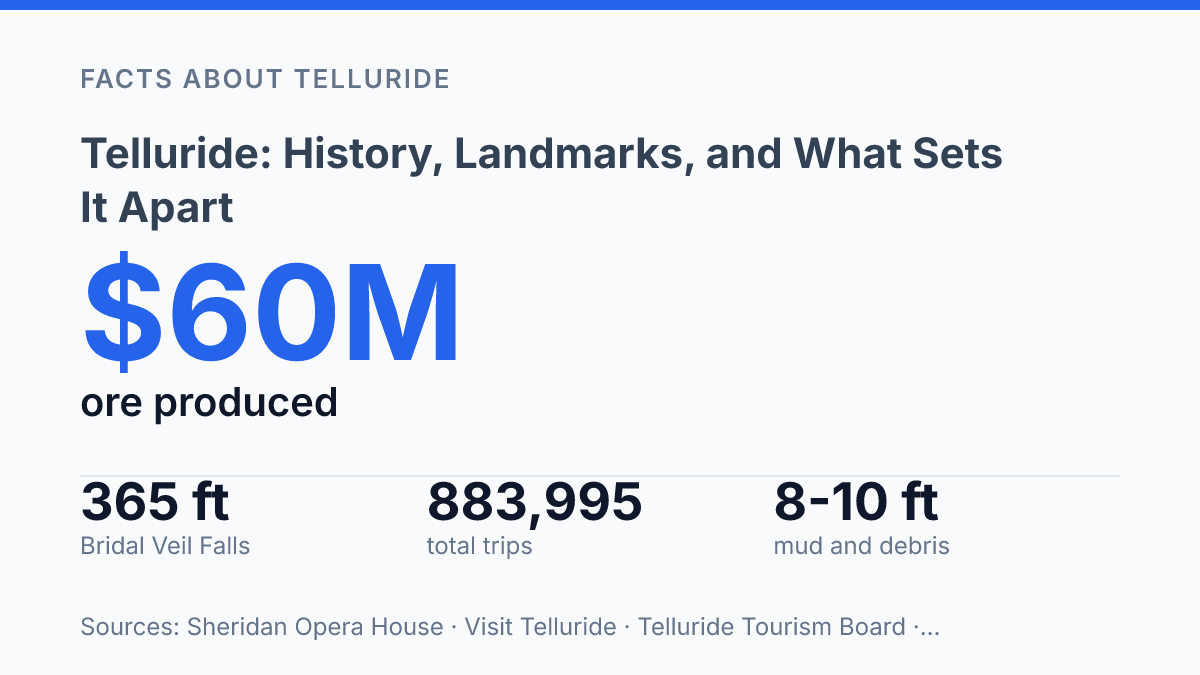
Telluride begins with a trap: a town wedged into a canyon so tight that Bridal Veil Falls drops 365 feet at the road’s eastern end.
That beauty comes with teeth. On July 27, 1914, a cloudburst sent an estimated 8 to 10 feet of mud and debris through town, turning the same steep walls that frame the view into a force multiplier.
That contrast is the key to the place. A tent camp became a mining town, then a protected historic district, then a high-altitude destination where old hotels, theaters, trails, and festivals all compete for attention. But the story isn’t a simple before-and-after. In my honest opinion, the best way to understand this mountain town is to see how geography kept squeezing it into sharper versions of itself.
Why the town sits in a box canyon
The town has almost nowhere to sprawl: cliffs and forested peaks press its streets into the flat floor of a dead-end canyon. Telluride sits in a box canyon in Colorado’s Rocky Mountains. That shape controls the whole feel of the place.
You don’t just see the mountains from town. You feel hemmed in by them.
Those canyon walls did more than create drama. They limited where roads, homes, shops, and public spaces could go. Expansion couldn’t spread evenly in every direction.
The town grew in a narrow corridor instead of becoming another loose mountain settlement. That constraint gives the streets their compact feel. It also makes land scarce and movement deliberate.
At the east end, Bridal Veil Falls drops 365 feet and is described as Colorado’s tallest free-falling waterfall, with Visit Telluride also warning that the route has winter avalanche and rockfall hazards. That single detail captures the bargain of the canyon.
The scenery is spectacular. The terrain doesn’t soften itself for human plans.
The same geography that made early access difficult now gives the town its pull. Forest-covered slopes rise close on multiple sides. The end-of-the-road setting makes arrival feel intentional. In my view, that enclosed feeling is the town’s strongest natural asset, not a limitation to be solved.
The resort base area near town adds a modern layer to that geography. Skiing draws people toward the surrounding slopes in winter, and golf stretches across high mountain terrain when the snow is gone.
Yet the resort setting doesn’t erase the canyon’s limits. As of 2026, the basic fact remains plain: the mountains decide the town’s edges before planners do.
How a mining camp became a historic mountain town
Before it had polished storefronts and protected streetscapes, Telluride was a tent camp built around ore, wages, weather, and risk. Municipal history records say it became a town in 1878, during Colorado’s late-19th-century mining surge.
The railroad arrived in 1890. That changed the scale fast.
By the early boom years, the settlement had grown into a community of about 5,000 people, according to the Town of Telluride. That number matters.
It shows this wasn’t a tiny prospecting outpost with a few cabins. It was a working industrial town with hotels, boarding houses, shops, schools, saloons, and civic life packed around mining money.
The wealth was real. It came from extraction. By 1909, the district had produced $60 million in mineral-rich ore, according to the Sheridan Opera House’s historical account. That figure gives the Victorian buildings their sharper edge.
The architecture looks charming now. It was funded by dangerous work, unstable markets. A labor system built to pull value from the mountains as quickly as possible.
Then the boom cracked. The 1893 silver crash hit mining communities across Colorado. This town was not spared.
Growth gave way to contraction. That’s the tension at the center of its heritage: the same streets now marketed for history once carried the stress of layoffs, injuries, speculation, and decline.
Preservation turned that complicated past into the town’s defining asset. In 1961, it was designated a National Historic Landmark District for its mining-boom era from 1878 to 1913. The town says it is one of only five Colorado communities with that status.
That designation didn’t freeze the place in time. It did set a public expectation that old buildings, street patterns, and visual character mattered.
In my honest opinion, the preservation story works because it doesn’t have to pretend the past was gentle. The town’s historic identity has power precisely because it holds two truths at once: beauty survived here.
It came from a hard, extractive economy. That contrast is what keeps the district from feeling like a stage set.
Landmarks that anchor the historic district
The most revealing building in the district seats just 238 people. It still pulls the town’s public life toward one small stage.
The Sheridan Opera House was completed in 1913 as a jewel-box theater tied to the New Sheridan Hotel, according to the venue’s own history. Today, it remains a performing-arts space, not a decorative relic behind glass.
That matters. A preserved theater can become a museum piece fast.
This one still asks locals and visitors to share the same room. Concerts, talks, film programs, and community gatherings give the building a present tense. In my humble opinion, that’s why it carries more weight than a handsome facade ever could.
A few blocks away, the Telluride Historical Museum tells a different story from inside a former place of care. The building opened in 1896 as Hall’s Hospital and served as the town hospital until 1964, according to the museum.
It reopened as a museum in 1966, then later went through a seven-year, $2 million restoration. That sequence gives the site unusual depth: illness, recovery, memory, and preservation all sit in the same rooms.
The wider district gets its character from concentration, not from one trophy landmark. Victorian-era commercial buildings, cottages, hotels, and civic structures sit close together.
The streets read as a whole rather than as scattered leftovers. You don’t need a plaque on every wall to feel the pattern.
Here’s the tension: these landmarks have to serve a living town under serious visitor pressure. Telluride/Mountain Village recorded 883,995 total trips in 2025, according to the Telluride Tourism Board’s annual report. That number brings money and attention.
It also turns old sidewalks, small venues, and preserved interiors into working infrastructure. The district succeeds when preservation doesn’t freeze daily life. It has to hold both at once.
Why visitors come for more than scenery
Few mountain towns ask visitors to choose so little: lift access, fairways, theaters, galleries, and century-old storefront blocks all sit within a place small enough to cross on foot. That mix changes the rhythm of a stay.
You don’t feel split between a resort zone and a historic downtown. The pieces press close together.
That proximity gives the town its real pull. A skier can finish the day and step straight into a street grid that still feels handmade.
A golfer can spend the afternoon above town, then return to sidewalks lined with old commercial fronts instead of anonymous resort corridors. In my view, the strongest reason people return isn’t the view. It’s the rare feeling that culture, sport, and street life still share the same few blocks.
Culture fills the gaps between seasons. Concert halls, gallery spaces, film events, lectures, and small performance rooms give visitors a reason to come when snowpack or summer weather isn’t the main story.
The local tourism board’s 2025 annual report counted 395,494 overnight trips, a figure that points to more than day-trip photo traffic. It also reported an average daily lodging rate of $670, which says demand stays high even when access and rooms aren’t cheap.
Festival numbers make the point sharper. The town’s Bluegrass Festival debrief recorded daily crowds from 9,130 to 10,559, still below the 12,000-person cap.
About 3,000 campers came with the event, and 71% of waste was diverted from landfill. Those figures show a place trying to host large cultural gatherings without letting them swallow the town whole.
Walking changes how visitors read the place. Cars fade into the background once you’re inside the small core. That matters.
You notice building fronts, alleys, signs, porches, and shop windows at human speed. The town rewards attention in a way drive-through destinations don’t.
The tradeoff is real. The same compact scale that makes the town feel intimate can make peak-season crowds feel sharper, louder, and harder to absorb.
Smallness is the charm, but it’s also the limit. That tension is part of the identity, not a flaw to ignore.
What the canyon asks of every visitor
The next honest question isn’t what to see. It’s how to move through a place this small without treating it like a backdrop.
That matters more as the Telluride Bluegrass Festival shows what pressure looks like at scale. In 2025, the event diverted 71% of its waste from landfill, but crowd discipline still mattered as much as policy.
Book earlier, walk more, respect closures, and read hazard signs like they were written for you. In my humble opinion, the best visitors don’t just admire the canyon. They leave fewer marks on a town that has already survived ore booms, floods, crashes, and fame.
Frequently Asked Questions
Q: What is Telluride known for?
A: Telluride is known for its preserved Victorian mining-town core, its mountain setting. A historic district that still feels lived-in. The draw isn’t just the scenery… it’s the mix of old buildings, cultural venues. A ski-and-golf resort right at the base of the canyon. 1913 is the year the Sheridan Opera House opened. That detail says a lot about how deep the town’s story runs. In my view, that’s what sets it apart from places that only look historic.
Q: Is Telluride a real historic mining town?
A: Yes. Telluride began as a Victorian mining town in Colorado’s Rocky Mountains. That past still shapes the way the town looks and feels today. The historic district hasn’t been scrubbed clean for tourists. It keeps the older character front and center, and that’s a big part of the appeal.
Q: What historic landmarks can you visit in Telluride?
A: Two standouts are the Sheridan Opera House and the Telluride Historical Museum. The opera house was originally built in 1913. The museum sits in a converted hospital from 1896, so you’re looking at buildings with real age and a clear second life. That mix matters… one is for performance, the other for memory.
Q: Why is Telluride’s location so unusual?
A: Telluride sits in a box canyon, surrounded by forested peaks. That geography gives the town a tight, enclosed feel that you don’t get in most mountain communities. It also makes the setting feel dramatic in a way that’s hard to ignore. 1 canyon setting defines the whole experience, and that’s the point.
Q: Can you visit Telluride for more than skiing?
A: Absolutely. The town sits at the base of a popular ski-and-golf resort. The historic district gives you a second reason to go beyond the slopes. You can spend the day looking at preserved buildings, a 1896 museum building. A 1913 opera house… then head back for outdoor time.